Where Neutrality Expires
On Dis-Chem, Redi Tlhabi, and the Strange Medicine of Corporate Morality

I. The Pharmacy of Contradictions
I have been a Dis-Chem customer for years.
My diabetic tablets.
My cholesterol medication.
My thrombosis medication.
Month after month, quietly collected in little white packets across a pharmacy counter. Like many South Africans, I trusted the routine. Medicine is intimate. It enters your bloodstream. Your life slowly arranges itself around these small rituals of care.
And perhaps that is why this moment unsettled me more deeply than I expected.
Because racism always feels different when it enters ordinary spaces.
Not parliament. Not Twitter. Not ideological battlegrounds.
But the places where people buy insulin, aspirin, baby formula, and blood pressure tablets.
The pharmacy aisle is supposed to be neutral ground.
A place of healing.
A place where human fragility is recognised equally.
Yet neutrality, it seems, becomes very interesting when Palestine enters the aisle.
II. “Just a Shareholder”
The public relations language arrived quickly.
Dis-Chem distanced itself.
The company is “apolitical.”
“Non-partisan.”
The shareholder does not represent the company.
We have heard this language before.
Corporations love neutrality the way empires love maps. It helps them move through the world without moral fingerprints.
Yet the controversy surrounding Mark Saltzman and his attacks on journalist Redi Tlhabi did not emerge in isolation. It emerged within a wider global atmosphere — one in which criticism of Israel’s destruction of Gaza is frequently met with intimidation, accusation, ridicule, or attempts at moral silencing.
Redi Tlhabi understood this immediately.
What disturbed many South Africans was not merely disagreement. We are a noisy democracy. Disagreement is ordinary. What disturbed people was the tone — the aggression, the misogyny, the entitlement, and the assumption that public influence and philanthropy could somehow purchase moral obedience.
And then came the old corporate manoeuvre:
“This individual does not represent us.”
But consumers are not stupid.
People know that corporations are not only balance sheets. They are ecosystems of power, investments, relationships, protections, and tolerated behaviour.
A billionaire shareholder is never merely a random uncle shouting into the wind.
III. South Africans Know This Smell
Perhaps what global corporations still fail to understand is this:
South Africans possess a deep historical sensitivity to the language of “neutrality.”
We come from a country where banks funded Apartheid while calling themselves neutral.
Where corporations profited from racial suffering while speaking the language of stability and order.
Where injustice often wore a tie, issued statements, and sponsored charity events.
That memory has not disappeared.
And this is why Palestine resonates so deeply here.
Many South Africans do not see Gaza as a distant geopolitical abstraction. They recognise patterns:
segregation,
militarised control,
dehumanising language,
collective punishment,
and the demand that oppressed people remain “reasonable” while being destroyed.
This does not mean every South African agrees on every detail of the conflict. But it does mean many recognise the moral smell of selective humanity.
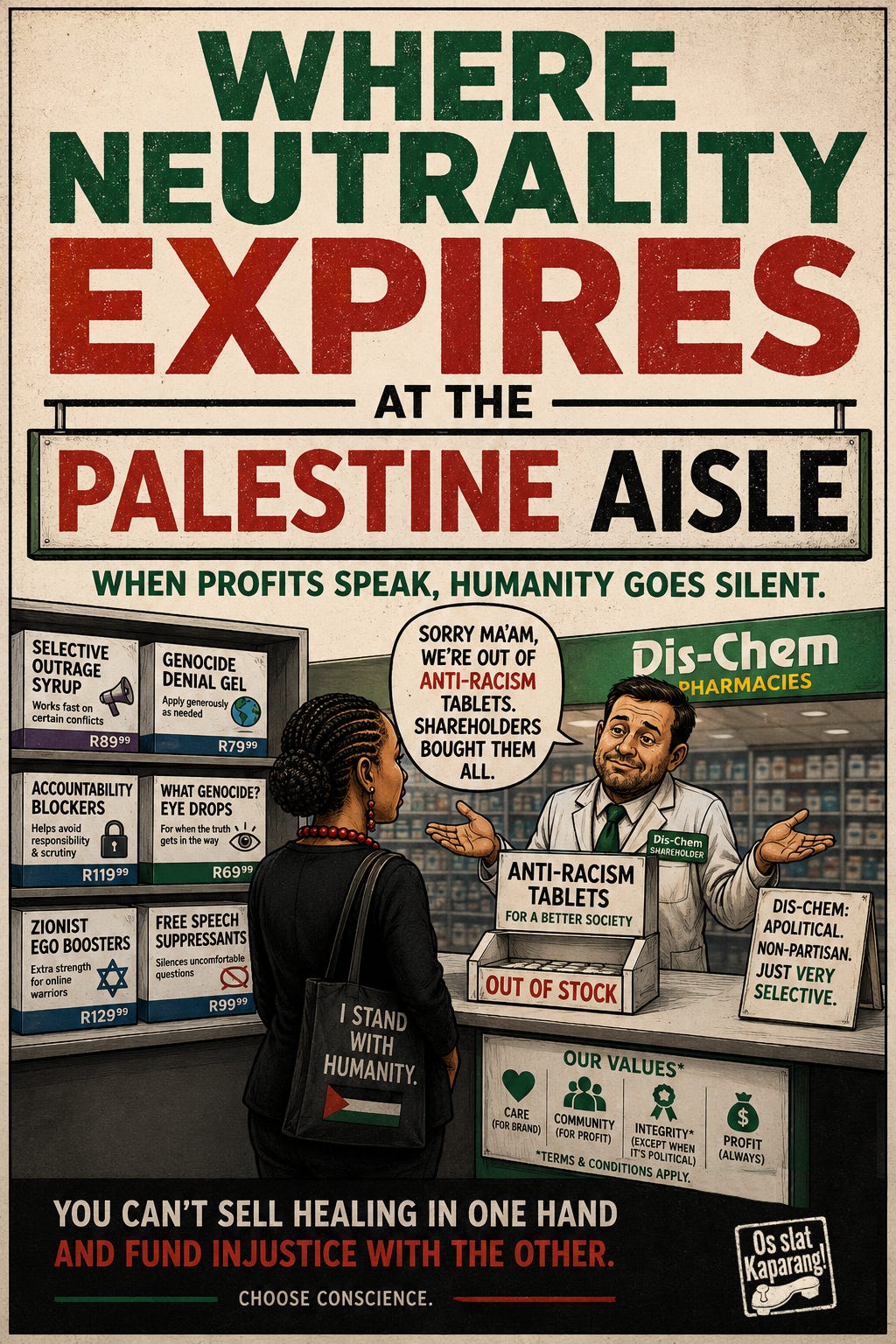
IV. The Cartoon Explained Everything
Ironically, it was satire that clarified the moment for me.
A cartoon.
A fake pharmacy shelf.
“Selective Outrage Syrup.”
“Genocide Denial Gel.”
“Accountability Blockers.”
“What Genocide? Eye Drops.”
And at the centre:
“Sorry ma’am, we’re out of anti-racism tablets. Shareholders bought them all.”
People laughed.
But satire works precisely because absurdity has already entered reality.
The cartoon spread because many people instinctively understood the contradiction:
a company associated with healing suddenly appearing emotionally numb to suffering elsewhere.
Not all contradictions can be solved through public relations.
Some become symbolic.
V. Redi Tlhabi and the Refusal to Bend
What I admired most in this moment was not outrage, but composure.
Redi Tlhabi did not collapse into hysteria.
She did not become theatrical.
She remained intellectually grounded, morally clear, and publicly dignified.
That matters.
Because one of the oldest habits of power is to provoke emotional chaos in order to discredit moral witness.
But witness is strongest when it remains steady.
And perhaps that is why the attacks became so revealing. They exposed something larger than one argument online. They exposed the growing discomfort of powerful interests when ordinary people — journalists, activists, citizens — refuse to outsource their conscience.
VI. The Strange Future of Consumer Morality
I do not know whether I will continue supporting Dis-Chem.
That is the uncomfortable truth.
Because modern consumers increasingly face ethical entanglements everywhere:
banks funding destruction,
corporations profiting from war,
brands performing inclusivity while enabling exclusion,
public neutrality masking private investments.
Late capitalism asks us to purchase convenience while suppressing conscience.
Yet something is changing globally.
People are beginning to ask:
What exactly are we funding?
And once that question enters the bloodstream, it does not leave easily.
VII. The Medicine We Actually Need
Perhaps the deepest tragedy of our age is not only racism itself, but the endless sophistication used to disguise it:
as policy,
as investment,
as neutrality,
as security,
as “personal opinion.”
But ordinary people still recognise dignity when they see it.
And they recognise cruelty too.
The shelves may remain stocked with tablets and vitamins.
The loyalty cards may continue scanning.
The profits may continue flowing.
But moral trust, once fractured, is not so easily repaired.
Some medicines take years to work.
And some poisons do too.