When Empires Learn New Languages
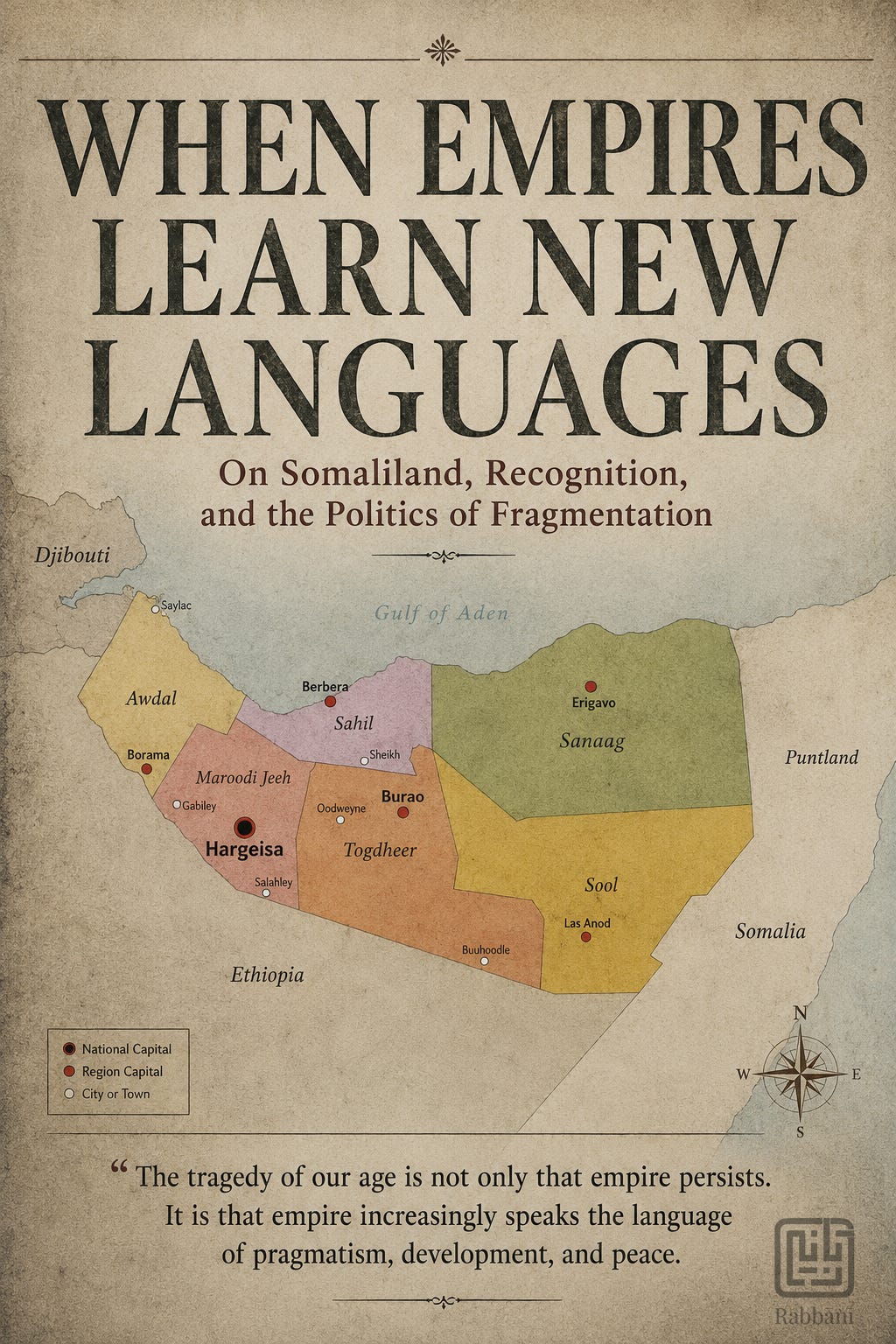
On Somaliland, Recognition, and the Politics of Fragmentation

There are moments when an old memory suddenly becomes political again.
A photograph. A book cover. A congratulatory message posted almost casually into the stream of social media.
And then something unsettles inside you.
Not outrage.
Recognition.
I had been following the reports surrounding Somaliland’s deepening relationship with Israel — embassy exchanges, recognition, strategic cooperation, the language of normalisation. Somaliland, the self-declared republic that broke away from Somalia in 1991 after the collapse of the Siad Barre regime, now seemed to be entering another geopolitical orbit altogether.
The announcement carried the familiar vocabulary of modern diplomacy:
recognition, security, partnership, stability.
But for many of us shaped by the afterlives of colonialism, those words are never innocent for very long.
Then another memory returned.
Years ago, I encountered the work of Professor Iqbal D. Jhazbhay, the South African academic, diplomat, and former ambassador whose scholarship engaged extensively with Somaliland. His book, Somaliland: An African Struggle for Nationhood and International Recognition, framed Somaliland through the language of reconciliation, reconstruction, and African self-determination.
And to be fair, Somaliland’s story is not fictional.
The suffering under Siad Barre was real. The destruction was real. The attempt to rebuild internal peace, civic order, and functioning institutions was real too.
This is precisely why the matter becomes difficult. Because the modern world rarely presents itself in simple moral arrangements anymore.
A people may carry legitimate wounds and still become absorbed into larger strategic games. A language of liberation may slowly merge with the language of empire. Recognition itself — once associated with dignity and sovereignty — may begin to function as currency within wider geopolitical negotiations.
And this is where the unease begins.
Not because Somaliland is uniquely guilty of something.
Nor because all aspirations toward self-determination are false.
But because history has taught some of us to become cautious whenever maps begin moving again.
Especially when powerful states suddenly become interested in “recognising” fragments.
For those shaped by African memory, the pattern is difficult to ignore:
partition, buffer states, protectorates, homelands, strategic enclaves, and borders drawn in rooms far away from the people who must eventually live inside them.
Empires once arrived with armies and flags.
Today, they often arrive speaking the language of partnership.
II. Somaliland Is Not Simple
To speak honestly about Somaliland requires resisting two temptations at once.
The first is romanticism. The second is dismissal.
Too much commentary about the Horn of Africa collapses into propaganda almost immediately — either Somaliland becomes a heroic democratic miracle, or it becomes nothing more than a geopolitical pawn. Reality, as always, is more difficult and more human than either slogan allows.
Somaliland emerged from catastrophe.
The violence and repression under Siad Barre left deep scars across northern Somalia. Entire communities experienced bombardment, displacement, disappearance, and collapse. When the Somali state disintegrated in 1991, Somaliland declared independence not as an abstract academic exercise, but as a response to historical trauma and political abandonment.
What followed was not insignificant.
Clan elders, civic leaders, religious figures, and local communities participated in long processes of reconciliation and reconstruction. In a region marked by fragmentation and warlordism, Somaliland managed to cultivate relative internal stability, functioning institutions, and forms of political continuity that drew attention from across Africa and beyond.
Many African intellectuals, diplomats, and scholars therefore saw in Somaliland something admirable:
an indigenous attempt at rebuilding society from below.
That admiration was not irrational.
Even figures like Professor Ali Mazrui — one of Africa’s great anti-colonial intellectuals — saw something compelling in Somaliland’s struggle for recognition. That matters. It reminds us that Somaliland cannot simply be dismissed as fiction, manipulation, or fantasy.
The difficulty lies elsewhere.
History repeatedly shows that authentic aspirations for dignity can later become absorbed into wider imperial architectures. A wound may be real and still become strategically useful. A liberation narrative may begin sincerely and yet slowly enter the orbit of powers whose interests have little to do with liberation itself.
And this is precisely why the present moment carries such tension.
Because history teaches us that genuine wounds can still become geopolitical entry points.
A people may sincerely seek dignity while larger powers simultaneously seek leverage. Local aspirations and imperial interests often intersect in ways that are morally disorienting. The tragedy is that one reality does not cancel the other.
This is especially true in the Horn of Africa — a region long shaped by external appetites:
Ottoman, British, Italian, French, American, Gulf, Chinese, and now increasingly Israeli strategic interests moving through ports, shipping lanes, military agreements, and Red Sea security calculations.
The Horn rarely gets to exist peacefully outside someone else’s map.
And so the question becomes more difficult than simply asking whether Somaliland “deserves” recognition.
One must also ask:
recognition by whom, recognition toward what end, and recognition within which global architecture of power?
Because in our time, recognition is never merely symbolic.
It is economic, military, strategic, and civilisational.
And once recognition enters the bloodstream of empire, the language around it begins to change.
Suddenly fragmentation becomes “stability.”
Military footholds become “partnership.”
Strategic dependency becomes “cooperation.”
The vocabulary softens long before the consequences arrive.
This is why some of us watch these developments with unease rather than celebration.
Not because Somali suffering was unreal.
Not because Somalilanders are incapable of political agency.
But because history has made us attentive to the moment when local pain becomes useful to global power.
That moment changes everything.
III. The Return of the Mapmakers
For much of the twentieth century, empire announced itself loudly.
It arrived with gunboats, charters, flags, missionary language, military occupation, and racial theories pretending to be science. The violence was visible enough that future generations could point backward and say: there, that was colonialism.
Our age is more sophisticated.
Empire now prefers softer vocabularies:
partnership, recognition, security, normalisation, trade corridors, and stability.
The language changes long before the structure does.
And nowhere is this more visible than in the politics of fragmentation.
Across the modern world, one repeatedly encounters the same geopolitical pattern:
wounded regions transformed into strategic zones,
breakaway territories becoming diplomatic leverage,
ethnic and historical fractures entering the calculations of larger powers.
Ireland partitioned. Korea divided. Palestine carved and occupied. Sudan split apart.
Apartheid South Africa constructing Bantustans under the language of “separate development.”
Every empire eventually learns that managing fragments is often easier than confronting unified political memory.
The map becomes an instrument of administration.
And over time, even the language of self-determination can be folded into this logic. Genuine aspirations for dignity become entangled with military routes, port access, intelligence agreements, resource corridors, and spheres of influence stretching across oceans.
This is what makes the Horn of Africa so vulnerable.
The Red Sea is not merely water. It is one of the great arteries of global trade and military movement. Whoever influences the Horn influences shipping routes, energy flows, migration corridors, and strategic access between Africa, the Middle East, and Asia.
In such a landscape, recognition is never neutral.
An embassy is never only an embassy. A port is never only a port. A diplomatic gesture is never merely symbolic.
And so when Israel — itself sustained through a long architecture of occupation, partition, militarisation, and settlement — suddenly moves toward recognising Somaliland, many of us cannot help hearing older echoes beneath the newer language.
Not because Somalilanders themselves are reducible to imperial puppets.
But because empires have always known how to enter history through fracture.
First comes recognition, then cooperation, then security arrangements, and finally strategic dependency dressed in the language of mutual interest.
And by the time the architecture becomes visible, the moral vocabulary surrounding it has already softened.
This is why the old anti-colonial generation often carried such suspicion toward partition politics. They had seen too many maps redrawn in rooms far away from the people whose lives would be altered by the lines.
They understood something our age sometimes forgets:
Every empire redraws maps.
The enduring question is who benefits when the lines move.
IV. When Recognition Becomes Currency
There is another transformation that occurs quietly in modern geopolitics:
recognition itself becomes currency.
Not dignity alone. Not solidarity alone. But leverage.
States denied recognition begin searching for powerful sponsors. Powerful states, in turn, begin discovering strategic opportunities inside unresolved histories. Gradually, recognition stops functioning as a moral principle and starts functioning as transaction.
You recognise me. I align with you. You protect me. I provide access.
And beneath the diplomatic language, a deeper architecture slowly forms.
This is why the Somaliland–Israel relationship unsettles so many people across Africa and the Muslim world. It is not merely about embassies. It is about what kinds of political and military arrangements recognition eventually makes possible:
ports, security cooperation, intelligence relationships, shipping influence, Red Sea positioning, and the expansion of regional influence through carefully cultivated alliances.
The modern empire rarely demands obedience immediately.
First it offers visibility.
And this is where the matter becomes spiritually difficult.
Because human beings — individuals and nations alike — become vulnerable when dignity has been deferred for too long. Recognition begins to feel salvific. International acknowledgment becomes emotionally charged. The hunger to finally “arrive” before the world can slowly reshape political judgment itself.
Empires understand this psychology well.
They understand wounded aspirations, diplomatic loneliness, and the seduction of being finally seen.
And so they learn new languages.
Not the language of conquest alone, but the language of validation.
This is why I find myself thinking again about spiritual traditions, especially Sufism, which at its best taught inward independence before worldly proximity. The true dervish was never meant to become intoxicated by courts, rulers, or access. The function of the spiritual witness was not to orbit power, but to remain morally awake in its presence.
Yet history repeatedly shows how easily spiritual language itself can become domesticated by political realism.
One begins by speaking the language of justice. Then comes strategy, then access, then calibration.
Eventually one no longer notices how much of the original moral horizon has quietly shifted.
This is not unique to Somaliland.
Nor to Muslims.
Nor to Africa.
It is one of the oldest stories in political history:
the gradual accommodation between wounded idealism and imperial architecture.
And perhaps that is what unsettles me most.
Not that empires continue playing their games — they always have.
But how often the language of liberation slowly learns to speak with the accent of empire itself.
V. The Sufi Witness
The older Sufi traditions carried through exile, colonisation, slavery, and occupation were rarely detached from history. Tuang Yusuf arrived at the Cape as an exile of empire. Tuang Guru wrote Qur’an from prison cells. Across Africa, Sufi orders often stood within anti-colonial struggle long before modern nationalism had found its language.
The true Sufi witness was not someone who withdrew from the world, but someone who learned how to see through it: how greed disguises itself as civilisation, how domination disguises itself as stability, and how empire constantly renames its appetites.
The issue is not whether spiritual people should engage politics—they always have—but whether spiritual traditions retain the moral independence necessary to speak truth when power changes hands.
History offers many examples of scholars, mystics, diplomats, and religious leaders who opposed one form of domination only to become comfortable with another. The language changes. The alliances change. The justifications change. Yet the temptation remains remarkably familiar.
The Sufi witness is tested precisely here: not when resisting obvious oppression, but when power arrives carrying invitations, recognition, access, and strategic opportunity.
A people can lose their moral bearings long before they lose their territory. Perhaps this is what anti-colonial spiritual traditions tried to protect: not merely land, but orientation — the ability to remain inwardly free before the seductions of access, recognition, and strategic usefulness.
Perhaps this is the burden of witnessing in our age: to remain capable of hearing the old imperial music even after the instruments have changed.
VI. Recognition, Security, and the Red Sea
Perhaps this is why the developments around Somaliland can no longer be understood solely through the language of recognition.
Recognition was the beginning.
What follows is something else.
In recent months, reports have emerged of deepening security cooperation between Israel and Somaliland, including military training arrangements, strategic discussions surrounding Red Sea access, and claims—contested by various parties—of Israeli personnel operating inside Somaliland. Whether every report proves accurate is ultimately less important than the direction of travel itself.
The vocabulary has already changed. Recognition becomes cooperation. Cooperation becomes security. Security becomes strategic presence.
And strategic presence begins reshaping the political meaning of an entire region.
This is what makes the Red Sea so significant.
To the casual observer, it appears as geography. To states and military planners, it is infrastructure.
The Red Sea links Europe, Asia, the Gulf, and East Africa. It carries energy routes, commercial shipping, military deployments, and some of the most important maritime corridors in the contemporary world. Whoever secures influence across the Horn secures influence far beyond the Horn itself.
This is why seemingly local developments rarely remain local for long.
A diplomatic agreement in Hargeisa echoes through Mogadishu. A security arrangement reverberates through Addis Ababa. A military calculation reaches toward Yemen, Gaza, the Gulf, and the wider Indian Ocean.
The map has become interconnected.
And this is precisely how modern empire increasingly functions.
Not through direct rule alone. Not through occupation alone. But through networks: access agreements, intelligence relationships, military cooperation, and strategically positioned partnerships that appear limited when viewed individually but become transformative when viewed together.
The old colonial world carved territory visibly.
The new imperial world often manages corridors.
Trade corridors, security corridors, energy corridors, and military corridors.
And everywhere along those corridors stand smaller nations trying to navigate systems far larger than themselves.
This is why moral clarity becomes difficult.
Weak states seek protection, wounded peoples seek recognition, regional powers seek influence, and global powers seek access.
The tragedy is that these aspirations frequently intersect.
And when they do, the language of justice and the language of strategy begin borrowing from one another.
This, perhaps, is where Palestine remains morally central.
Not because every situation is identical, but because Palestine reveals what happens when strategic logic gradually overtakes ethical imagination. Once security becomes the highest political vocabulary, almost anything can eventually be justified:
walls, surveillance, siege, fragmentation, settlements, occupation, and endless militarisation presented as necessity.
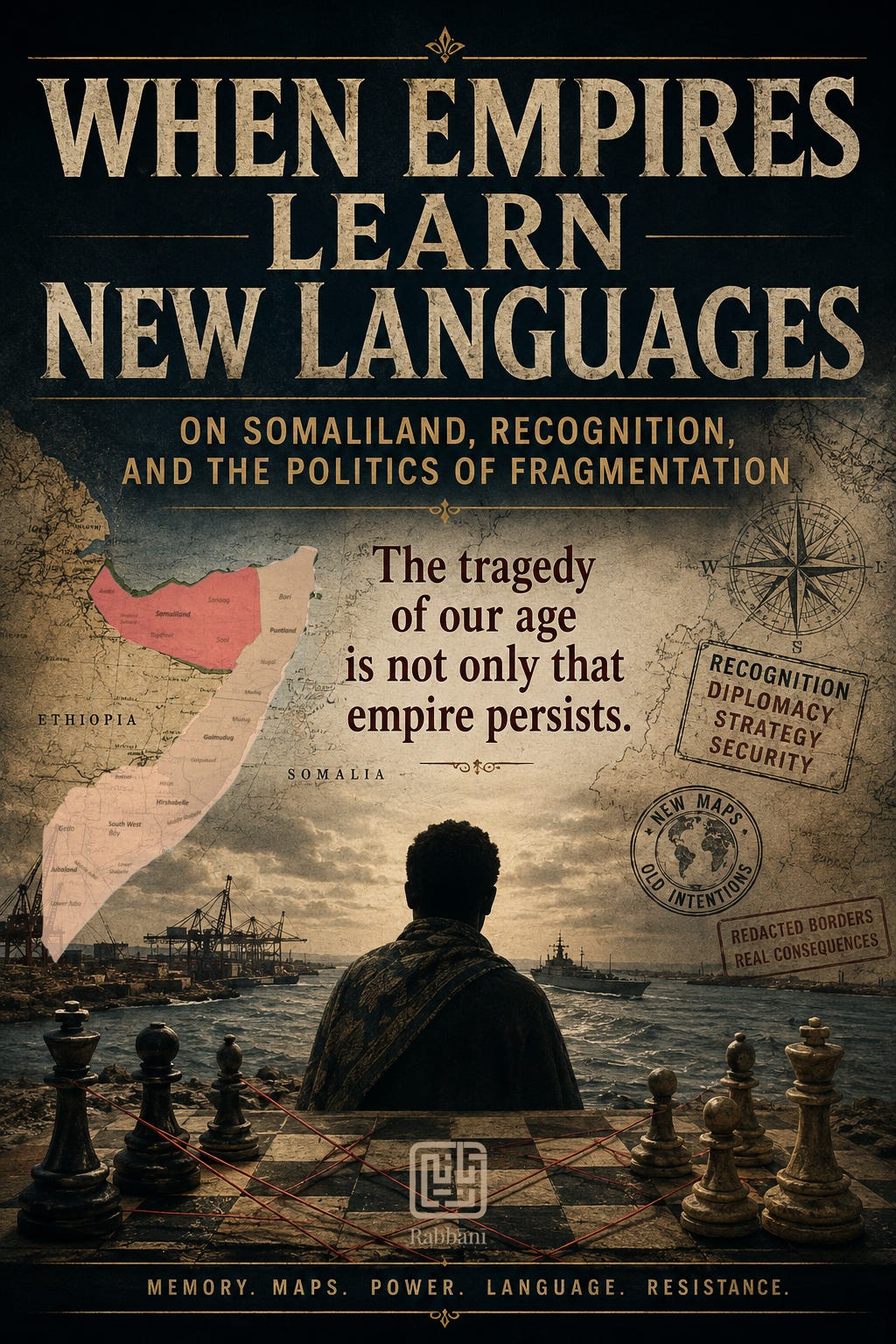
The tragedy of our age is not only that empire persists.
It is that empire increasingly speaks the language of pragmatism, development, partnership, and peace while continuing to reorganise the world around unequal power.
And so one watches a liberation narrative becoming increasingly entangled within a larger architecture of power.
The question is no longer whether Somaliland sought recognition, but what forms of power now travel in its wake.
Because history has taught us that empires rarely enter fractured regions announcing themselves honestly.
Usually they arrive offering recognition.
VII. Final — The Witness and the Map
We once believed maps described the world.
Then history taught us that maps also describe appetite.
Lines move. Borders shift. New states emerge. Old alliances collapse.
Empires rename themselves and return carrying different vocabularies.
And somewhere beneath all of this, ordinary people continue searching for dignity, safety, recognition, and a future large enough to hold their children.
Perhaps this is why the present moment feels so spiritually heavy.
Because we are living through an age in which the language of liberation and the language of empire increasingly borrow from one another. Recognition sounds like solidarity until it becomes leverage. Partnership sounds like mutuality until dependency quietly enters the room. Fragmentation sounds like freedom until the wider architecture surrounding it finally becomes visible.
And still the world continues speaking in the language of strategy.
Ports, routes, alliances, security arrangements, regional influence.
Rarely do we pause long enough to ask what prolonged fragmentation does to the soul of a continent.
Africa already knows the inheritance of partition too well.
The carving of memory, the management of tribes, the cultivation of buffer states, and the rearrangement of peoples according to external interests dressed as inevitability.
Perhaps this is why some of us watch these developments with concern rather than surprise.
The history of suffering is real. The aspirations toward dignity are real. But so too are the older imperial instincts that repeatedly learn how to inhabit the language of recognition, diplomacy, and stabilisation.
The Sufi witness, at its best, does not surrender moral clarity to geopolitical fashion. It tries to remain awake enough to hear when power changes its accent. It remembers that not every invitation into the global order is innocent, and not every strategic partnership arrives without appetite.
Most importantly, it refuses forgetfulness.
Forgetfulness of Palestine, forgetfulness of colonial memory, and forgetfulness of how easily domination learns to speak softly before it begins reorganising the world again.
And so perhaps the task in our age is not merely to choose sides inside every emerging fracture.
Perhaps the deeper task is to remain capable of seeing the mapmakers themselves.
To ask: Who benefits from fragmentation? Who profits from instability? Who gains access when borders move? Who disappears when the lines are redrawn?
Because every empire eventually learns new languages.
The real struggle is ensuring that we do not forget how to hear the old intentions still speaking beneath them.